
Your Online Reputation Is Your New Handshake: A Guide for Insurance Businesses

Marketing isn’t exactly most wholesalers’ first love.
But in the insurance world, what’s more important than your reputation?
For generations, a firm handshake and a trusted referral were the gold standard for building a rock-solid network. Today, that handshake happens on a Google search results page, long before you ever get in the same room.
Brand reputation marketing online is just the digital version of what the best in the business have always done: proactively shaping how people see you. It’s the art and science of monitoring, promoting, and acquiring positive content—like stellar partner testimonials and thought-leadership articles—to build trust and attract the right retail agents and carriers before you ever exchange a business card.
This isn’t about putting out fires. It’s about building a fireproof reputation from the ground up.
Why Your Digital First Impression Is Everything

For MGAs, wholesale brokers, and carriers, reputation has always been the ultimate currency. But now, your future partners—the exact retail agents and program managers you want to work with—are vetting you online right now. They’re glancing at your website, checking out your leadership team on LinkedIn, and scrolling through what others are saying about your programs.
What they find (or don’t find) is their first impression. And in this business, you don’t get a second chance to make one.
Your Online Presence Is Your Digital Lobby
Think of your online presence as your digital lobby. Is it professional, insightful, and welcoming? Or is it gathering dust with an outdated website and zero recent activity? A weak digital footprint doesn’t just make you look behind the times; it plants a seed of doubt. If you can’t get your own digital house in order, how can a retail agent trust you with their most complex accounts?
A strong one, on the other hand, builds instant credibility.
Understanding the importance of online reputation management is the first real step toward protecting your brand and driving growth. It’s a non-negotiable piece of any serious strategy for digital marketing in the insurance industry.
In a relationship-driven business like insurance, trust is everything. Your online reputation is now the primary vehicle for establishing that trust at scale, turning a cold search into a warm introduction.
Bottom line: online brand reputation isn’t a fluffy, optional extra. It’s a critical business function. It’s how you ensure your digital presence accurately reflects the expertise, reliability, and value you bring to your partners every single day.
Building a Rock-Solid Digital Foundation
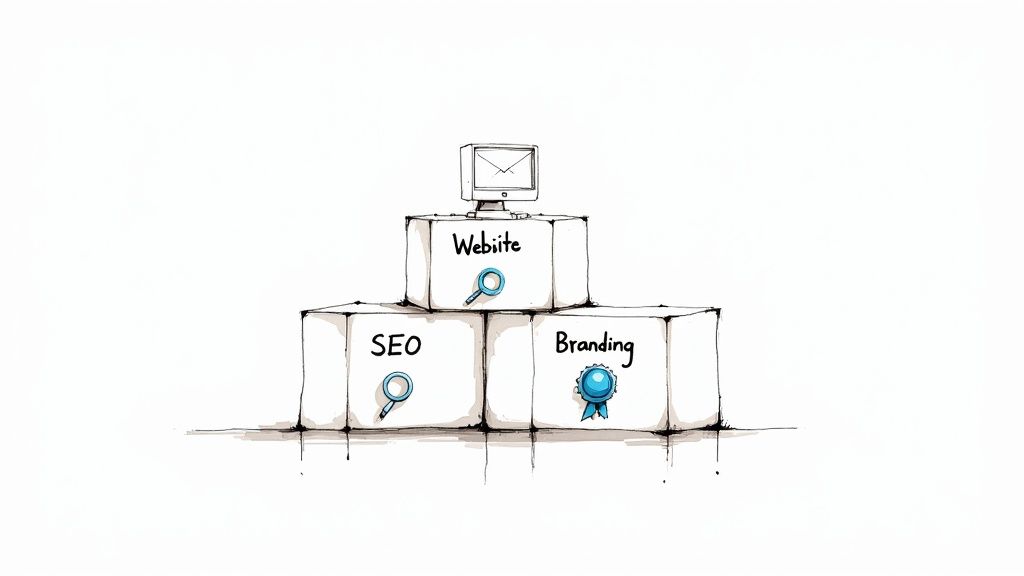
You can’t build a great reputation on a shaky foundation. Before you can even think about managing your brand online, you have to get the basics right—the digital assets you completely control.
If your website hasn’t been updated since the last hard market, it’s time for an intervention.
Your digital footprint is everything. It’s your website, your LinkedIn Company Page, your executives’ profiles, and even the signature on your emails. Each one is a puzzle piece, and together they create the complete picture of your brand for potential partners.
Your Website: The Digital Front Door
Your website is the absolute center of your digital universe. When a prospective retail agent or carrier partner goes looking for your specialty program, your website is almost always their first stop. It has to scream professionalism and expertise from the moment it loads.
A modern, easy-to-navigate site builds subconscious trust. A clunky, outdated one does the exact opposite, sending a clear signal that your business operations might be just as inefficient. It’s the digital equivalent of showing up to a big meeting in a wrinkled suit.
Search Engine Optimization (SEO) Is Not a Dark Art
So many insurance professionals get intimidated by SEO, but it’s really just about making it easier for search engines like Google to find you and understand what you do. For an insurance business, this is everything.
You want to be the first name that pops up when a retail agent searches for “MGA for high-risk coastal property” or “wholesale broker for cyber liability.” That’s what SEO does for you.
Good SEO ensures that when someone is actively looking for the solutions you provide, you are there to greet them. It’s the single most powerful way to control your online narrative because it puts your best foot forward first.
This isn’t about tricking the system. Think of it as clearly labeling your digital files so the world’s biggest filing cabinet can find them instantly. If you’re just getting started, our guide on SEO for insurance agencies breaks down the core concepts specifically for insurance pros.
Brand Consistency Builds Trust
Finally, consistency is the glue that holds all of this together. Your logo, your messaging, and your tone of voice need to be uniform across every single platform.
Take a hard look at your assets:
- Your LinkedIn Page: Does it reflect the same level of professionalism as your website?
- Executive Profiles: Are your key people positioned as the experts they truly are?
- Email Signatures: It’s a small detail, but it’s a vital one that reinforces your brand with every single message you send.
This consistency creates a seamless, trustworthy experience. It signals that your business is stable, professional, and pays attention to the details—and that’s the bedrock of any successful brand reputation strategy.
Mastering Online Reviews and Social Proof
Let’s get one thing straight: reviews aren’t just for restaurants and Amazon products. In the insurance world, testimonials from the retail agents and carrier partners you serve are pure gold. They’re the digital equivalent of a glowing referral passed along at an industry conference.
Think about it. When a retail agent is deciding between your MGA and a competitor, what do they do? They look for signals of trust and reliability. A few solid, positive reviews on your Google Business Profile or recommendations on LinkedIn can absolutely be the tiebreaker.
This isn’t about getting lucky. It’s about having a process. A huge part of brand reputation marketing online is proactively—and ethically—encouraging feedback from your satisfied partners.
The Art of the Ask
Most happy partners are more than willing to share their positive experiences, but they’re busy people. You almost always have to make the first move. The trick is to make it incredibly easy and to ask at just the right time.
- Strike while the iron is hot. The perfect moment to ask for a review is right after a big win, like when you’ve successfully placed a complex account or delivered exceptional service during a tough claim.
- Keep it simple. Don’t make them hunt for where to leave a review. Send a direct link to your Google Business Profile or LinkedIn page. A simple, personal email asking for their feedback is far more effective than some generic, automated blast.
Responding to Every Review: The Good, The Bad, and The Awkward
How you respond to a review is often more telling than the review itself. Ignoring feedback—whether it’s positive or negative—is a massive missed opportunity. A thoughtful reply shows you’re engaged and that you actually value your business relationships.
When you get negative feedback, a calm, professional public response is critical. Acknowledge their issue, restate your commitment to service, and then offer to take the conversation offline to resolve it. This one move demonstrates accountability to every single person who reads that review later.
Acknowledging criticism with grace can do more for your reputation than a dozen five-star reviews. It proves you’re a real partner, not just a fair-weather one.
The numbers don’t lie. With 97% of users checking out a business’s online footprint before they even think about engaging, the cumulative effect of your reviews shapes your entire brand perception. Responding publicly proves you’re accountable, a quality that resonates deeply in the world of insurance.
Building a library of positive feedback also gives you fantastic raw material for compelling case studies and testimonials. You can sprinkle these powerful endorsements throughout your website for maximum impact. For more on this, check out our guide on how to effectively use social proof on your website.
Shaping Your Narrative with Proactive Content
If you don’t tell your own story, someone else will. A passive approach to reputation management is like playing defense—you’re just reacting to whatever comes your way. Proactive content, on the other hand, is your offense. It’s how you take control of the narrative and build authority on your own terms.
For insurance businesses, this means creating content that proves you’re not just another vendor but an indispensable partner. It’s not about churning out generic blog posts. It’s about sharing your deep industry expertise in a way that helps your retail agent partners win.
From Expertise to Authority
You live and breathe complex risks and niche markets every single day. The trick is to turn that specialized knowledge into tangible, reputation-building assets.
- Insightful Market Analysis: Publish articles on emerging liability trends or the constant shifts in the hard market. This shows you’re not just keeping up; you’re looking ahead.
- In-Depth Whitepapers: Develop a definitive resource on a tough topic, like navigating new cyber threats or underwriting unique property risks. This positions you as a go-to specialist.
- Practical Webinars: Host a session for retail agents to break down a new program or coverage type. This delivers genuine value and forges direct connections.
This kind of content does more than just fill up your website. It populates Google’s search results with your expertise, pushing your brand to the top when potential partners are looking for real answers.
Your best online reputation strategy is to become the go-to source for valuable, industry-specific information. When you educate, you earn trust—the most valuable currency in insurance.
To help get the wheels turning, here’s a quick-glance table to spark some content ideas tailored for MGAs, Wholesalers, and Carriers to build authority with their retail agent partners.
Reputation-Building Content Ideas for Insurance Businesses
| Content Type | Best For | Reputation Goal |
|---|---|---|
| Market Trend Reports | Wholesalers, Carriers | Demonstrate forward-thinking expertise and market leadership. |
| In-Depth Case Studies | MGAs, Wholesalers | Prove success in placing complex or niche risks. |
| “How-To” Guides for Partners | MGAs, Carriers | Provide practical value and become an educational resource. |
| Expert Q&A Webinars | All | Showcase internal talent and build personal connections. |
| Coverage Comparison Sheets | MGAs, Wholesalers | Simplify complex products and highlight unique advantages. |
| Whitepapers on Emerging Risks | Carriers | Establish authority on cutting-edge industry challenges. |
Ultimately, the goal is to create resources that your partners can’t find anywhere else, making your brand an essential part of their success.
Demystifying Digital PR
Think of digital PR as getting your expertise featured in places your ideal partners already know and trust. It’s basically a high-powered referral. Getting one of your executives quoted in an industry publication or featured on a popular insurance podcast provides powerful third-party validation that you can’t buy.
This also taps into the power of trusted voices. The rise of influencer marketing has fundamentally changed reputation strategies. Today, 61% of consumers trust influencer endorsements more than traditional advertising, and for good reason—it feels more authentic. You can dig into more of these social media marketing statistics here.
Of course, “influencers” in the insurance world are more likely to be respected underwriters or industry analysts than social media stars. But the principle is exactly the same: aligning your brand with trusted figures builds your credibility.
Getting Your Social Listening Strategy in Place

You can’t manage what you don’t measure. In the insurance world, that usually means keeping an eye on loss ratios or submission volume. But for your online brand reputation, it means listening closely to what people are saying about you.
This is the defensive side of reputation management, better known as social listening. And no, we’re not talking about chasing viral memes or keeping up with TikTok trends. For insurance businesses, this is a strategic early-warning system.
Think about the real conversations happening on platforms like LinkedIn, in private industry forums, or even in the comment section of a trade journal’s latest article. These are the places where your reputation is actively being shaped, whether you’re part of the conversation or not.
What to Listen For
Setting up a solid listening strategy is easier than it sounds. It really just starts with knowing which signals to tune into. At a bare minimum, you should be tracking any and all mentions of:
- Your company name: This is the obvious one, catching direct feedback and discussions right away.
- Key executives’ names: The personal brands of your leadership are directly tied to your company’s reputation. What’s said about them is said about you.
- Unique product or program names: Are brokers buzzing about that new cyber liability program you launched? You need to know.
- Your top competitors: Watching what people say about them can reveal market gaps, pain points, and huge opportunities for your own business.
Social listening is the difference between spotting a small spark of misinformation and having to fight a raging wildfire later on. It lets you be proactive instead of reactive.
This proactive approach is critical for building trust. With 81% of consumers saying they need to trust a brand before buying, being present and responsive in these digital conversations is no longer just a “nice-to-have.”
Remember, it often takes 5 to 7 impressions for a brand to build that essential trust. Each positive interaction you create by listening is another step in the right direction. You can dig into more of the numbers in this helpful breakdown of online reputation statistics.
Even simple, free tools can be set up to send you alerts whenever your chosen terms are mentioned online. This allows you to jump in and address concerns before they escalate, thank a partner for a kind word, or clarify a complex coverage detail. It shows you’re not just broadcasting—you’re actually listening and engaged with your market.
Got Questions? We’ve Got Answers
You’re not alone. When we talk with insurance professionals about building a brand online, the same questions pop up again and again. Here’s our take on the most common ones.
How Much Time Does This Actually Take Every Week?
Let’s be realistic—you’re not going to spend all day on this. The goal is consistency, not intensity. For most MGAs and wholesalers, setting aside 2-4 hours a week is plenty.
This isn’t about aimlessly scrolling through feeds. It’s focused, deliberate work:
- Checking in on brand mentions.
- Responding to new reviews and comments (the good and the bad).
- Engaging with your network on LinkedIn.
- Mapping out your next piece of helpful content.
Think of it like checking in with your key producers. It’s an ongoing investment in a critical relationship, not a one-and-done task. A little bit of attention each week makes a massive difference.
For an MGA or Wholesaler, What’s the One Platform We Can’t Ignore?
If you force us to pick just one, it’s LinkedIn, hands down. Your website is your digital home base—that’s non-negotiable. But LinkedIn is where the entire B2B insurance world gathers.
It’s where your top people cement their expertise and where you share the kind of insights that make high-value retail agents want to work with you. A solid company page is great, but it’s the active, professional profiles of your leadership team that truly signal credibility. It speaks directly to the people you want to attract.
Your LinkedIn presence is your virtual industry conference. It’s where relationships are built, expertise is showcased, and partnerships begin. Neglecting it is like skipping the biggest event of the year.
We Got a Negative Review. Should We Just Ignore It?
Absolutely not. Ignoring a bad review is probably the worst thing you can do. Why? Because your response isn’t just for the person who left the comment—it’s for every single potential partner who reads it from now on.
A calm, professional, and public reply is your best move. Acknowledge their frustration, briefly state your commitment to service, and immediately offer to take the conversation offline to find a solution. This approach shows you’re accountable and that you take feedback seriously. In other words, it turns a negative into a public demonstration of your professionalism.

