
Maximize Growth with Commercial Insurance Leads Generation

The old ways of finding commercial insurance leads are collecting dust.
If you’re still relying solely on handshakes and golf course deals to fill your pipeline, you’re leaving a massive amount of money on the table. Modern commercial insurance leads generation is a digital game, and your best prospects are already online, researching solutions long before they ever think about picking up the phone.
Your Prospects Have Changed. Are You Keeping Up?

The days of being the sole gatekeeper of insurance information are long gone. Today’s commercial insurance buyers are more informed, more skeptical, and far more self-sufficient. This isn’t about giving up on relationships; it’s about building a powerful digital engine that feeds those relationships with better, more qualified opportunities from the start.
This isn’t a small shift; it’s a fundamental change in how B2B buyers operate. Research shows that a staggering 74% of commercial buyers start their insurance search online. This makes a strong digital footprint non-negotiable for any MGA, wholesaler, or carrier that wants to compete. Decision-makers use search engines and professional networks like LinkedIn to find and vet potential partners before they ever make contact. You can dig into more data on this trend by reviewing these insights on modern lead generation tactics.
The Great Digital Migration
So, what does this actually mean for your insurance business? It means your website, your content, and your social media profiles have become your new front door. Before a potential partner even thinks about requesting a quote, they’ve probably already:
- Googled their specific problem (like “MGA for high-risk construction”) and judged you based on where—or if—you showed up.
- Clicked through your website to see if you look credible, professional, and like you actually know what you’re talking about.
- Checked out your company’s LinkedIn profile to gauge your expertise and see what you’re sharing.
If you’re invisible during that critical research phase, you’re not even in the game. You’ve lost the opportunity before you even knew it existed.
The goal isn’t just to be online; it’s to be the resource your audience finds when they’re looking for answers. Your marketing should solve their problems before they even have to ask, building trust and authority with every click.
Out with the Old, In with the Effective
Let’s put this into perspective. The comfortable, familiar tactics that worked a decade ago just don’t deliver the same results today. They aren’t totally useless, but if they’re the only tools in your toolbox, you’re setting yourself up for stagnation.
To see how the playbook has evolved, take a look at this quick comparison of outdated tactics versus the high-impact digital strategies that are driving growth for insurance businesses today.
Modern vs. Traditional Lead Generation Channels
| Channel Focus | Traditional Approach (Low ROI) | Modern Approach (High ROI) |
|---|---|---|
| Outreach | Generic cold calls and mass email blasts | Personalized, account-based email and LinkedIn campaigns |
| Content | Static brochures and sales-heavy flyers | Educational blog posts, webinars, and market reports |
| Networking | In-person events and conferences only | A blend of targeted events and consistent digital networking |
| Advertising | Print ads in trade magazines with no tracking | Highly targeted pay-per-click (PPC) and social media ads |
The modern approach isn’t about working harder; it’s about working smarter. It’s all about precision, using data effectively, and providing genuine value. This guide will give you a no-fluff playbook for what actually works in today’s market, helping you build a lead generation system that attracts the right partners and fuels sustainable growth.
Building Your Inbound Lead Machine

Let’s face it—marketing isn’t exactly most wholesalers’ first love. But an inbound lead strategy isn’t about flashy ads; it’s about becoming a magnet for the exact partners and clients you want to work with. Think of it as your silent salesperson, working 24/7 to attract the right opportunities.
When an insurance professional hits a wall with a tricky risk, where’s the first place they go? Google. Your goal is to be the answer they find. This isn’t about casting a wide, hopeful net. It’s about creating a system that pulls in qualified prospects who are already searching for your specific expertise.
SEO: The Unsung Hero of Insurance Marketing
Search Engine Optimization (SEO) is the foundation of any real inbound plan. It’s the behind-the-scenes work of making your website more visible to search engines for the exact terms your target audience is using.
If your website isn’t showing up on the first page of Google for relevant searches, you might as well be invisible. Effective SEO for insurance businesses isn’t about stuffing your site with keywords; it’s about understanding what your audience is trying to accomplish and giving them the information they need.
The key is to think like your audience. They aren’t just searching for “commercial insurance.” They’re looking for solutions to specific, pressing problems.
Here are the types of keywords that actually matter:
- Problem-Based Keywords: Terms like “coverage for vacant commercial property” or “cyber liability for tech startups.” These show immediate need.
- Product-Specific Keywords: Think “D&O insurance for nonprofits” or “high-limit commercial auto MGA.” These attract prospects who know exactly what they want.
- Question-Based Keywords: Phrases like “what is surplus lines insurance” or “how to place hard-to-insure risks.” These help establish you as an authority.
Answering your audience’s most pressing questions through your online content is the fastest way to build trust. When you solve their problems before they even contact you, you’re not just a vendor; you’re a valuable partner.
Creating Content That Actually Works
Content is the fuel for your inbound engine. But let’s get one thing straight: this isn’t about churning out generic blog posts that no one reads. It’s about creating valuable resources that solve real-world problems for insurance professionals. To do this right, understanding specific B2B SEO strategies for lead generation is non-negotiable.
Your content should aim to educate, inform, and build credibility. Forget the hard sell. Instead, focus on demonstrating your expertise and making your audience’s job easier.
Actionable Content Ideas for Insurance Businesses:
- Market Updates and Analysis: Publish quarterly reports on market conditions for a specific line, like construction or transportation. This positions you as a forward-thinking expert.
- Risk Management Guides: Create detailed guides on mitigating risks in niche industries. A wholesaler could create a “Cybersecurity Checklist for Healthcare Providers,” for example.
- Appetite Guides: Make your appetite guides easy to find, read, and understand. A clear, well-designed online appetite guide is one of the most powerful lead-gen tools an MGA or carrier can have.
- Case Studies: Showcase how you solved a complex problem for a business partner. Detail the challenge, the solution you provided, and the positive outcome.
The goal is to turn your website from a static digital brochure into a dynamic, resource-rich hub. Every piece of content you create is another opportunity to attract a qualified lead. By consistently providing value, you build an asset that generates opportunities long after you hit “publish.”
Mastering Outbound and Account-Based Strategies
While a solid inbound strategy is great for bringing opportunities to your door, a smart outbound plan lets you hunt for the high-value accounts you know you should be working with.
This isn’t about blasting out generic emails from a purchased list or making annoying cold calls. That’s the old way, and frankly, it’s dead.
The modern playbook is all about a targeted, sophisticated strategy known as Account-Based Marketing (ABM). Think of it as flipping the old marketing funnel on its head. Instead of casting a wide net and hoping for the best, you hand-pick your ideal future partners first. Then, you build hyper-personalized campaigns designed to get their attention.
It’s about proactively filling your pipeline with the right kind of business, not just waiting for it to show up.
Building Your Ideal Account List
The success of any outbound effort lives and dies by the quality of your target list. A small, hyper-relevant list will always crush a massive list of lukewarm prospects. This is where precision and data become your best friends.
Your ideal account profile isn’t just about industry or revenue; it’s about the specific DNA of businesses that are a perfect fit for your programs.
Start by defining your bullseye:
- Industry Niche: Do you have a killer program for transportation or construction? Get specific. Don’t just target “construction”—aim for “commercial GCs in the Southeast with over $50M in revenue.”
- Risk Profile: What types of complex risks do you excel at placing? Find the companies that wrestle with those exact challenges day in and day out.
- Business Signals: Look for triggers that signal a need. Are they expanding into new states? Did they just get a round of funding? Are they hiring for roles that scream growth?
Forget about volume. The point of modern outbound isn’t to talk to everyone; it’s to start meaningful conversations with the right ones. A well-researched list of 50 perfect-fit accounts is infinitely more valuable than a generic list of 5,000.
The Art of Personalized Outreach
Once you have your target list, it’s time to craft outreach that actually gets opened. Generic, one-size-fits-all messages are a one-way ticket to the trash folder. Personalization is what cuts through the noise and shows you’ve done your homework.
This is especially true on a platform like LinkedIn, which is still the undisputed king of B2B channels. A personalized connection request followed by a relevant, value-first message works wonders compared to a blunt sales pitch.
Here’s how to make your outreach compelling:
- Reference a Specific Pain Point: “I noticed your company is expanding its fleet operations. Managing insurance for a growing fleet can be a major headache, especially around DOT compliance.”
- Share a Relevant Insight: “Our latest market report for the tech sector highlights emerging D&O risks that might be on your radar. Thought you might find the data useful.”
- Mention a Common Connection or Event: “I saw that we’re both connected with Jane Smith at XYZ Carrier. I’ve always been impressed with her team’s work in the casualty space.”
Multi-Channel Persistence Pays Off
Don’t put all your eggs in one basket. The most effective outbound campaigns layer their approach, combining email, LinkedIn, and maybe even a strategic phone call. People have different communication habits, and a multi-channel strategy multiplies your chances of getting a response.
A typical sequence might look something like this:
- Day 1: Send a personalized LinkedIn connection request.
- Day 3: Follow up with a concise, value-focused email.
- Day 7: Engage with their content on LinkedIn (like or comment on a post).
- Day 10: Send a second email with a fresh piece of value, like a relevant case study.
This methodical, respectful persistence is what separates professional outreach from spam. It shows you’re serious about building a relationship, not just closing a quick deal. By combining a targeted list with personalized, multi-channel outreach, you build a powerful engine for generating high-quality commercial insurance leads.
Leveraging Technology and Data to Fuel Growth
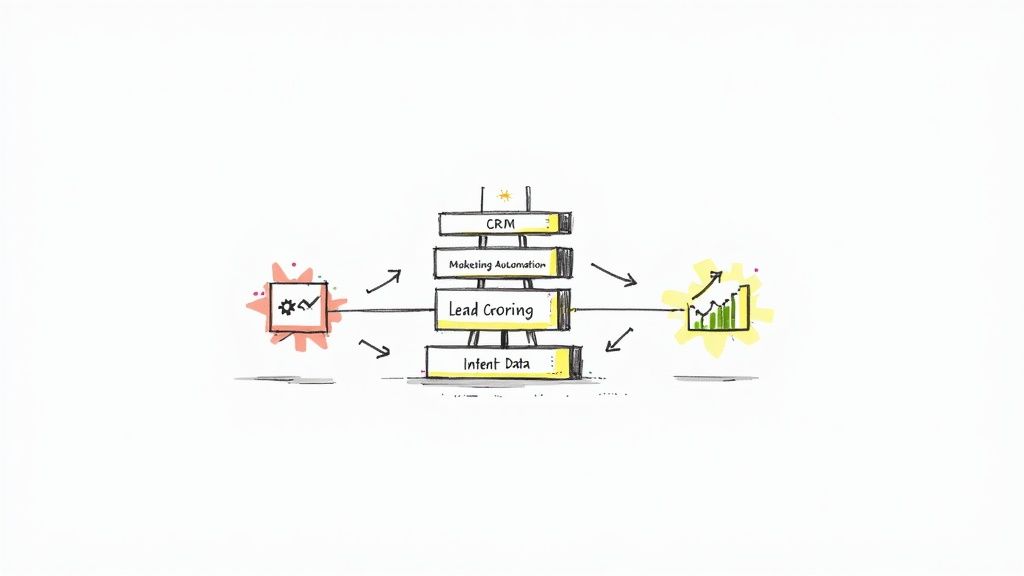
Let’s get one thing straight: great marketing runs on great data. Without the right technology, even the most brilliant strategy is just expensive guesswork. For any MGA, wholesaler, or carrier looking to scale up their commercial lead generation, a solid tech stack isn’t a luxury—it’s the engine.
This isn’t about chasing every shiny new tool that hits the market. It’s about building a simple, integrated system that gives you a clear view of your pipeline, automates the grunt work, and helps you make smarter decisions that actually move the needle.
Your CRM Is Your Single Source of Truth
If you only invest in one piece of technology, make it a Customer Relationship Management (CRM) system. Too many insurance professionals see a CRM as just a glorified digital address book, but its real power lies in making your entire sales and marketing process visible and measurable.
A well-used CRM tracks every single touchpoint—every email opened, every call made, every website visit. This creates a rich history for each prospect, giving your team the context they need to have meaningful conversations instead of flying blind.
It finally moves you from guessing what’s working to knowing for sure. You can finally answer the big questions:
- Which marketing campaigns are bringing in the most valuable opportunities?
- How long does it take for a new lead to become a serious prospect?
- Where are deals getting stuck in our pipeline?
Putting Lead Nurturing on Autopilot
Let’s be honest, your team is swamped. Manually following up with every single lead, consistently, is a recipe for missed opportunities. Things will inevitably fall through the cracks. This is exactly where marketing automation comes in.
These platforms connect directly to your CRM to nurture leads at scale, sending the right message at the right time without anyone lifting a finger.
Think of automation as your tireless assistant. It ensures every new lead gets a prompt welcome, every lukewarm prospect gets a gentle nudge, and your team only gets alerted when a lead shows genuine buying signals. It’s about working smarter, not harder.
You can set up simple “drip” campaigns that educate prospects over time, positioning your MGA or carrier as the go-to expert. This keeps you top-of-mind, so when a renewal date approaches or a new need arises, you’re the first call they make. The world of AI is rapidly expanding, offering even more powerful ways to personalize these interactions. You can even explore tools like ChatGPT for lead generation to enhance your initial outreach and qualification efforts.
Finding the Hottest Leads with Scoring and Intent Data
Not all leads are created equal. Some are just kicking tires, while others are ready to talk business right now. Lead scoring is a system that automatically ranks your prospects based on their behavior, helping your team focus on the ones most likely to convert.
It’s a simple points system based on actions:
- A prospect downloads your appetite guide: +10 points.
- Someone visits your “Contact Us” page: +15 points.
- An email hasn’t been opened in 90 days: -5 points.
Once a lead hits a certain score—say, 50 points—the system automatically flags them as a “hot lead” for immediate follow-up. No more wasting time on cold trails.
To take this a step further, look into intent data. This gives you powerful signals about businesses that are actively researching insurance solutions across the web. This data can identify companies searching for specific coverages or even visiting competitor websites, allowing you to swoop in with a perfectly timed message. It’s the closest thing you can get to a crystal ball in commercial insurance.
Why Investing in Lead Generation Is Non-Negotiable
Thinking of marketing as a cost center is one of the fastest ways to fall behind in the insurance game. Let’s be blunt: the most successful insurance businesses don’t see marketing as an expense. They treat it as a critical investment in their own survival and growth.
This isn’t about throwing money at flashy ads or sponsoring another golf tournament. It’s about making calculated investments into proven channels, tracking what works, and building a sustainable system that keeps your pipeline full. It’s the engine that powers your revenue, not a drain on your resources.
If you’re on the fence about allocating a real budget to commercial insurance lead generation, the data should settle the debate.
From Cost Center to Growth Engine
The old mindset of “if we build a great product, they will come” is a relic. Today, visibility is just as important as your underwriting expertise or claims service. A consistent, strategic investment in marketing is what separates the insurance businesses that thrive from those that merely survive.
The numbers don’t lie. Spending on insurance lead generation has hit unprecedented levels for a reason—it works. In fact, companies that devote more than 15% of their revenue to lead generation are far more likely to see substantial revenue growth.
Meanwhile, those spending less than 5% are nearly three times more likely to experience flat or declining revenues. It’s a stark reminder that sustained, strategic marketing is vital. You can dig into these insurance lead generation findings for a closer look.
This shift requires a change in perspective, especially when talking to stakeholders or leadership. The conversation needs to move from “How much will this cost?” to “What is the expected return on this investment?”
Justifying the Investment
Getting buy-in for a marketing budget in a traditionally conservative industry isn’t always easy. The key is to frame the investment in terms your leadership understands: growth, efficiency, and competitive advantage.
Here’s how to build a rock-solid business case:
- Benchmark Against Competitors: Point out what your forward-thinking competitors are doing. Are they running targeted digital ads? Are their executives active on LinkedIn? Highlighting their activities can create a healthy sense of urgency.
- Start Small and Prove ROI: You don’t need a multi-million dollar budget overnight. Propose a pilot project focused on a single, high-potential channel. Track the results meticulously and present a clear report showing leads generated, cost-per-lead, and potential revenue.
- Focus on the Cost of Inaction: What happens if you do nothing? Your pipeline shrinks, your brand becomes irrelevant, and you lose ground to more aggressive competitors. Sometimes, the risk of standing still is far greater than the risk of investing in growth.
Shifting the conversation from ‘expense’ to ‘engine of revenue’ is the first step. When leadership sees marketing as a direct line to new business, budget approvals get a whole lot easier.
Ultimately, investing in lead generation is a declaration that you’re serious about growth. It’s about taking control of your pipeline instead of leaving it to chance. In a crowded market, the insurance businesses that invest in being seen and heard are the ones that will win.
Balancing Digital Strategy with the Human Touch

In an industry built on trust, technology can never fully replace the human element. Let’s be clear: the ultimate goal of your digital marketing isn’t to close a complex commercial deal online. It’s to earn the right to have a meaningful conversation.
A slick website and some automated emails are powerful tools, but they’re just the opening act. The real work happens when a digital lead becomes a human connection. Making that transition seamless is what separates the winners from the noise.
The Critical Handoff
Despite the rush to digitize everything in insurance, the human touch remains the deciding factor. While 74% of commercial insurance buyers kick off their search online, only about 25% actually complete their purchase digitally.
Most still want to speak with a real professional before signing on the dotted line. In fact, a staggering 78% of insurance consumers will pick up the phone and call a business after finding them online, according to Semrush data on insurance consumer behaviors.
This is the critical handoff point. Your technology’s job is to tee up a warm, informed conversation for your team. It’s about using data to make your first real conversation feel like the second or third.
Why Relationships Still Rule
Technology opens the door, but expertise and relationships close the deal. No algorithm can replicate the confidence a client feels after speaking with a knowledgeable underwriter or broker who genuinely understands their unique risks.
Think about it this way:
- Automation can nurture a lead, but a human can navigate a tough negotiation.
- A CRM can track data, but a person can build genuine rapport.
- An ad can generate a click, but a conversation builds a long-term partnership.
The best commercial insurance lead generation strategies use high-tech digital outreach to enable high-touch, personal follow-up. One without the other is like having a powerful engine with no steering wheel—you’ll make a lot of noise but won’t get where you need to go.
This is the core of effective human-to-human (H2H) marketing. You’re not using technology to replace relationships but to make them better. By applying this mindset, you can see how H2H marketing works for your insurance business. Your digital efforts should warm up the conversation so your people can step in and do what they do best: build the trust that turns prospects into partners.
Ready to build a marketing engine that fills your pipeline with the right opportunities? At Direct Connection Advertising & Marketing, we specialize exclusively in the insurance industry. We’ll help you balance smart technology with the human touch needed to accelerate your growth.

